

Why does a baby fall asleep in your arms and wake ten minutes after being put down? Why is "just let them tire themselves out" such a poor plan? And what does the mattress have to do with any of it?
We put these questions to Dr. Sumitra Meena (MD Pediatrics) in a live Sleep Education session for parents. This is the written version: what she explained, checked against published pediatric guidance, with the full recording and the transcript of her talk below.

MD Pediatrics · founder of the Babynama app · speaker at the Flexrest Sleep Education session
In short
A newborn's sleep is built differently from ours: shorter cycles, more light sleep, and a body clock that has not started yet. Three habits do most of the work: a short bedtime routine that is the same every night, a dark room, and putting your baby down at the end of a wake window. And the surface matters more than most parents are told. It should be firm, flat and snug, with nothing else on it.
Watch by topic
Babies sleep differently, and there is a reason
Human babies are born early. Even at full term they need roughly another year of support to settle into sleep, which is why Dr. Meena says parents should expect to help until the first birthday, "not just three months, not just six".
For the first weeks a baby has no body clock of their own. Melatonin, the hormone that signals night, begins to be produced at around two months, and a day-and-night rhythm starts to appear around three months. It keeps maturing through the first year. Until then, a baby cannot be expected to fall into a routine, or to fall asleep alone.
- Shorter cycles. A newborn's sleep cycle is roughly thirty to fifty minutes, against ninety to a hundred and ten for an adult. A baby who drops off in your arms often wakes at the end of the first cycle after being put down.
- More waking. Every two to three hours at first, settling to one to three times a night by around six months.
- More light sleep. Babies spend a much larger share of the night in light sleep than adults do, and they have not yet learned to link one cycle to the next without help.
“That is why they need sleep help until one year of age, not just three months, not just six months.”
How much sleep, roughly
| Age | Total sleep in 24 hours, naps included |
|---|---|
| Newborn to 3 months | about 14 to 17 hours, in short stretches |
| 4 to 12 months | 12 to 16 hours |
| 1 to 2 years | 11 to 14 hours |
These are the ranges the World Health Organization gives for newborns and children. Dr. Meena's point is the same: they are ranges, not targets, and every baby is different.
Three habits that do most of the work
1. A short bedtime routine, the same every night
Twenty to thirty minutes is enough. A bath (or a sponge bath if it is hot), a gentle massage, night clothes, a feed, and from four or five months one short story. For a toddler, a few minutes of lively play after dinner, then dimmer lights, quiet talk and cuddles, then a book. Her experience with the families she sees: when the routine is fixed from the first weeks, most sleep problems never begin.
2. A dark room
Pitch dark at night helps the body release melatonin. A steady, soft background sound, such as a fan, is fine; babies do not need silence. Keep the room comfortably cool with good air flow, and dress your baby in no more than one layer more than you would wear yourself.
3. Wake windows
A baby builds up the need for sleep the longer they are awake. In the early months that window is short, often under an hour. A baby who naps too long in the day may have little appetite for sleep at night, and a baby kept up too long becomes overtired.
Learn the sleepy signs
Three stages. The earlier you act, the easier sleep comes.
Early
Start the routine now
Staring into the distance, slower movements, yawning, rubbing the eyes, going quiet. Aim to have your baby asleep within five to seven minutes.
Late
Settle straight away
Fussing, clinging, jerky movements, arching the back, rubbing the face against you. Skip the full routine.
Overtired
Slow down, stay calm
Suddenly wide awake and hyper, then inconsolable. The body is flooded with the stress hormone cortisol, and sleep gets harder, not easier.
Drowsy but awake
In the first three to four months you can move a baby who is already deeply asleep. From around four months, try to put them down drowsy but awake. They then wake on the same surface they fell asleep on, which helps them link one cycle to the next. Dr. Meena's explanation is simple: imagine falling asleep in one place and waking in another. A baby who can only fall asleep during a feed, with a bottle or with a pacifier may need the same thing at every change of cycle, which is why some babies wake again and again.
The surface your baby sleeps on
Dr. Meena called the sleep surface the number one factor in safe sleep that parents can control. Pediatric safe-sleep guidance says the same: a firm, flat surface with a fitted sheet and nothing else in the cot.
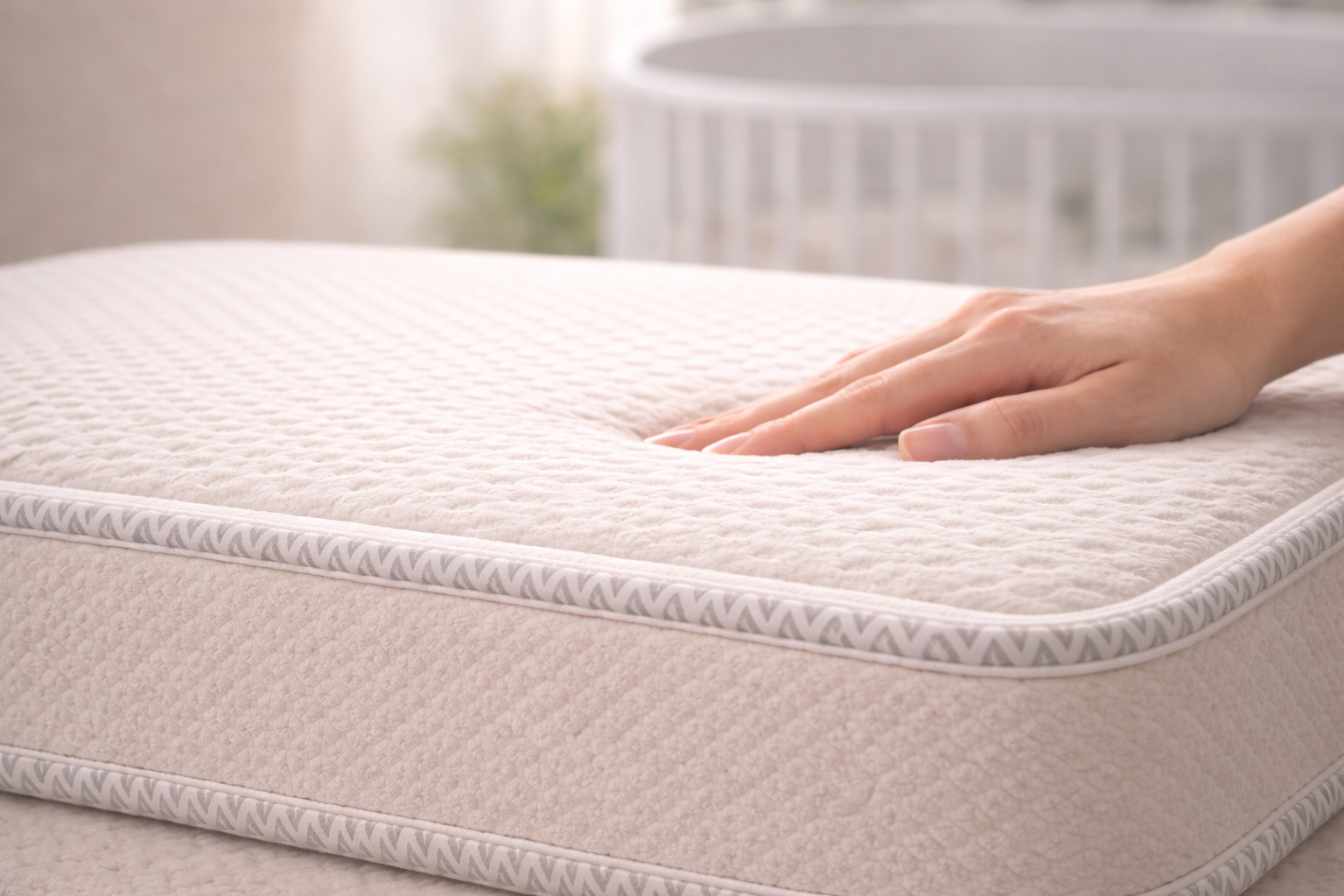
- Firm and flat. A baby placed on the mattress should stay on top of it. It should not sink, or mould around them the way an adult memory-foam or pillow-top mattress does.
- The hand test. Press your palm into the mattress and lift it. If it leaves a lasting imprint, the surface is too soft for an infant.
- Snug. No sagging, and no gap between the mattress edge and the cot side. (How to measure your cot.)
- Nothing else in the cot. No pillows, loose blankets, bumpers or soft toys.
- Alone, on the back, in a cot. The back is the safest position for every sleep, through the whole first year, as the WHO also advises. Side sleeping is not safer. Share a room, not a bed, for at least the first six months: keep your baby's own firm sleep space right beside your bed.
- Check older bedding. A cotton or foam mattress that was firm when new can lose its firmness with use. Replace or re-fill it, and test it again.
- Overheating, not air conditioning, is the concern. Dr. Meena stressed that a cool room with a fan or AC and light clothing is fine; over-dressing and a stuffy room are not.
Mattress labels do not always tell you how firm a surface really is, so the hand test above takes ten seconds and is worth doing yourself. We cover it in how firm should a baby mattress be.
In an Indian home
Dr. Meena spoke directly to Indian homes, and several of her points are about the way families here really sleep.
- Gaddas go soft. A cotton or foam gadda is firm when new but loses its firmness over time. Re-stuff or replace it every six to twelve months, and test it again.
- Floor beds can work. A mattress at floor height carries no risk of a fall, as long as it is firm. Use the hand test.
- Family beds are common. If your family shares a bed, the safest compromise is a separate firm sleep space for the baby right beside it, not in the middle of the adult bed.
- Heat. In hot weather a sponge bath, or just wiping the face, neck and arms, still works as a routine. A fan or AC with good air flow is fine; what matters is not over-dressing the baby.
- Jhoola and contact naps. Babies often settle well in a jhoola or on a parent's chest, and that is fine while you are watching. Once your baby is asleep, move them to a flat, firm surface. Do not leave a baby to sleep in a jhoola, swing or nest.
“The sleep surface is the number one modifiable factor for safe sleep, because it is in your hands.”
Sleep regressions are growth, not failure
Dr. Meena's reassurance on the most common question she gets: a "regression" is a developmental phase. Sleep tends to get harder around four months (the body clock arrives), at eight to ten months (crawling, pulling to stand), around eighteen months (language and molars) and around two years (imagination and fear of the dark). Through those weeks: more cuddles, keep to the routine most of the time, no screens, and expect that your baby may need extra help for a while.
A few myths, answered
- "Rice cereal in the bottle gives a longer sleep." No. It does not help, and it adds a choking risk.
- "Keep them up longer so they sleep better." No. An overtired baby sleeps worse.
- "Babies need complete silence." No. Gentle, steady sound often helps.
- "The air conditioner gives babies a cold." No. Viruses do.
- "By six months they will sleep through alone." Not realistic for most babies. Needing help for the first year is normal.
- Screens before bed. Avoid them in the hour or two before sleep, and for children under two avoid them altogether.
What to do, by age
| Age | Focus |
|---|---|
| Newborn to 3 months | No sleep training. Follow short wake windows, and expect to help your baby sleep every time. |
| 4 to 6 months | The sleep cycle forms. Keep a bedtime routine, a nap routine and wake windows. Start drowsy but awake. |
| 6 to 12 months | Naps settle to two or three. Choose a fixed bedtime and keep to it, rather than a different time each night. |
| 12 to 24 months | Many babies now fall asleep independently, if the routine has been kept up. |
When to see a doctor
Speak to your pediatrician if your baby snores regularly or seems to pause in their breathing, is not gaining weight, will only sleep upright, still wakes five or more times a night after twelve months despite a good routine, seems unrested after long sleep, bangs their head rhythmically in sleep, or is still falling asleep around midnight despite your efforts.
Questions parents ask
Why does my baby wake up ten or fifteen minutes after I put them down?
A newborn's sleep cycle is short, around thirty to fifty minutes, and young babies cannot yet link one cycle to the next on their own. Being moved from your arms to a different surface can also wake them. From about four months, putting your baby down drowsy but awake helps them learn to settle on the surface they will wake on.
How many hours should a baby sleep?
Newborns sleep about 14 to 17 hours a day in short stretches. Babies of 4 to 12 months need about 12 to 16 hours including naps, and children of 1 to 2 years about 11 to 14 hours. Every baby is different, so treat these as ranges.
How firm should a baby mattress be?
Firm, flat and snug. Press your palm into the mattress and lift it: if it leaves a lasting imprint, it is too soft for an infant. Read our guide on how firm a baby mattress should be, compare latex, coir and foam, or see our natural latex baby mattresses.
Is it safe for a baby to sleep on a soft mattress, memory foam or pillow-top?
No. A baby's face can sink into a soft surface, and memory foam moulds around the body. Use a firm, flat mattress that fits the cot with no gaps, and keep pillows, loose blankets and soft toys out of the cot.
Does air conditioning or a fan give a baby a cold?
No. Colds are caused by viruses, not by air conditioning. The concern is overheating: avoid over-dressing your baby and keep the room comfortably cool with good air flow.
When will my baby sleep through the night?
Not on a fixed date. A baby's body clock starts developing at around three months and keeps maturing through the first year, so many babies need help settling until about their first birthday. A steady bedtime routine, a dark room and wake windows make the difference.
Is it safe to share a bed with my baby?
Pediatric safe-sleep guidance advises against bed-sharing. Many Indian families sleep close together, so the safest approach is to keep your baby's own firm sleep space right beside your bed for at least the first six months, rather than in the middle of the adult bed.
When should I see a pediatrician about my baby's sleep?
If your baby snores regularly, seems to pause in their breathing, is not gaining weight, will only sleep upright, still wakes five or more times a night after twelve months, seems unrested after long sleep, bangs their head rhythmically in sleep, or is still falling asleep around midnight despite a good routine.
Eight things to remember
- Baby sleep is biologically different: short cycles and lots of light sleep.
- The body clock arrives around three to four months. No sleep training before that.
- A consistent bedtime routine is the single most powerful sleep tool.
- Make the room dark, and keep to wake windows.
- Dark, cool, a firm flat surface, nothing else in the cot.
- From about four months, put your baby down drowsy but awake.
- Sleep regressions are developmental phases, not failures.
- No screens before bedtime.
You are not failing. Every parent struggles with sleep. Ask for help, from family, from a pediatrician, or both. Rest for the parent is part of the plan.
Transcript of the presentation
Read the full transcript
Transcript of Dr. Meena's presentation, edited for clarity (filler words removed, Hindi passages translated). Introductions, the parents' questions and answers, and product discussion are in the video. Passages marked […] have been left out, including figures that could not be checked against published sources. Select a timestamp to jump to that moment in the recording.
The presentation: understanding baby sleep
00:23:10 Dr. Meena: So, moving forward, we are going to start the presentation and take questions at the end. Please keep all your questions for the end.
Today we will cover understanding baby sleep: how babies sleep, how the science works, because babies do not sleep like us. We do not fall onto the bed and go to sleep. That does not happen with a baby. And sleep hygiene practices are very different. Whenever I put a video on baby sleep and maybe say that sleeping on the back is important, or that sleeping on a separate surface is important, I get the traditional comments on the video: "Our parents also put us to sleep on the same mattress, and we grew up sleeping on it. Nothing happened to us."
[…]
Sleep surface safety we will discuss. SIDS, how to prevent SIDS, because parents do not know what really happens. SIDS is Sudden Infant Death Syndrome, and most of the time we cannot find the cause. But one commonly identified cause is the sleeping practice. Then we will discuss sleep myths and sleep management strategies, of course.
00:25:04 Dr. Meena: Now, coming to understanding baby sleep: how baby sleep is fundamentally different from adult sleep.
Why does sleep matter? Brain development, physical development, immunity, memory and learning, emotional health, maternal health. If the baby is sleeping well, of course the mother will get more sleep, and there are lesser chances of postpartum depression. […]
So it is very important that the baby sleeps appropriately. Not "My baby sleeps for fifteen to twenty hours", but the sleep is not that sound. If the deep sleep is not there, it will hamper brain development.
Physical growth: during sleep, growth hormone is released, which ensures that your baby is growing physically well. Immunity: sleep-deprived children will have lower immunity and will fall sick very frequently. Memory and learning: sleep is very important. Emotional health: poor sleep means more tantrums, more irritability, and worse emotional regulation. If you see that the baby is not sleeping during teething, the baby will act up, or maybe there is some other reason. If the baby is not sleeping well, the baby will throw more tantrums during the daytime, because sleep is very important for emotional health also.
00:26:57 Dr. Meena: Now, why does a baby sleep like a baby? Why does a human baby, unlike an animal baby, who walks and sleeps by itself right after birth and does not need sleep help or any kind of help, need it? Because human babies are born prematurely. Even at forty weeks they are born, but still they need another year, as if in the mother's womb. If you do the research, they need another one year. That is why they need sleep help until one year of age, not just three months, not just six months. They need help until one year, because they are born prematurely.
Now, how does a baby sleep in the womb? They just need sleep. They are getting ready-made food. They do not need to do anything. They sleep in the daytime, when the mother is moving, like a jhoola (a cradle swing). In the Indian common language, in a jhoola they sleep really well. But when the mother is resting, the baby will be awake and more active. The same sleep cycle they follow after birth until three months, zero to three months, because they do not have their own circadian rhythm like we do. They do not have the melatonin hormone like we do. That is why they need sleep. They need time to develop the circadian rhythm, the biological clock, and the melatonin hormone. That is why they sleep like a baby.
The science: circadian rhythm and sleep pressure
00:28:35 Dr. Meena: What is the science behind newborn sleep, and why is sleep necessary? We have to discuss what the circadian rhythm is. It is a twenty-four-hour internal body clock. Let me explain by example: if you sleep at seven o'clock, your body will start giving indications, "OK, now it is time to sleep." That is a biological clock. But babies, for the initial three months, do not have that internal body clock called the circadian rhythm.
Another term you need to understand is sleep pressure. Understand it like this: if the car is full of petrol, the car will run. So if the baby sleeps very well, the baby will be OK. The baby will be emotionally and physically OK. The baby will not throw tantrums.
Slowly, slowly, if the wake window is over, you can say the body is now tired, and then the sleep pressure will increase and the baby will demand sleep. That is called sleep pressure.
Why is this important to understand? Because when babies come to me for sleep consultation, they sleep too much in the daytime, and then they do not sleep at night, because they do not have any kind of sleep pressure. Few babies sleep in the night and then do not take daytime naps; they do not take a daytime nap because they have slept very well. So we have to manage this sleep-pressure thing if you want to make your baby sleep better. These two or three terms every parent needs to understand.
00:30:13 Dr. Meena: Key differences between baby sleep and adult sleep.
- Sleep cycle. Initially a baby's sleep cycle is thirty to fifty minutes. At six months it is around fifty to sixty minutes, and then ninety to a hundred and ten minutes, which is the adult cycle. It is not that we adults do not wake up either. Subconsciously we also get up after ninety to a hundred and ten minutes, but we go back to sleep because we can transition from one sleep cycle to another.
- What happens with babies? We put the baby to sleep, hold her in the lap for twenty minutes, then put her on the bed, and after ten to fifteen minutes she wakes up. Why? Because babies initially cannot transition from one sleep cycle to another. This is one reason. Another reason we will discuss, of course: the softness of the bed or mattress, and the Moro reflex. But this is one of the reasons.
- Night wakings. Every two to three hours in a baby. At six months, one to three times. Adults hardly, zero to one.
- Total sleep. Fourteen to seventeen hours, initially up to twenty hours. At six months, twelve to fifteen hours. In an adult, seven to nine hours.
- Circadian rhythm. As I told you, it is absent in a newborn, zero to three months. At three months it starts developing, but matures around one year. In adults, of course, it is mature.
00:32:11 Dr. Meena: When does the baby's body clock start? As I discussed earlier, there is no circadian rhythm at birth. At around nine weeks melatonin production starts, and then around three months the cortisol and melatonin hormone rhythm starts, and the circadian rhythm starts. That is why we tell parents that in the first three months you cannot expect the baby to fall into a routine. You cannot expect the baby to sleep by himself or herself. They really, really need your help.
Around four months the circadian rhythm is mostly established, and at six months the pattern matures. At one year it is a longer stretch and the baby will start sleeping.
00:33:01 Dr. Meena: How much sleep does your baby need?
- Zero to two months: around eighteen hours (eighteen to twenty). Night sleep is broken. Four to five naps, sometimes more than five.
- Two to four months: twelve to sixteen hours, and maybe sometimes seventeen to eighteen.
- Four to nine months: twelve to fifteen hours.
- Nine to twelve months: twelve to fourteen hours.
- Twelve to eighteen months: eleven to fourteen hours. My daughter is almost eighteen months now and sleeps around twelve hours.
- Eighteen to twenty-four months: about eleven to fourteen hours.
It depends from baby to baby. It is not that every baby sleeps fourteen hours at the same age.
Sleep regressions
00:33:53 Dr. Meena: This is the most commonly asked question: what is a sleep regression, how does it happen, and what should parents do? A sleep regression is a developmental phase, not really a "sleep regression" as such.
- Around four months. Babies now have the circadian rhythm and the sleep cycle forms, and they need more cuddles. At this time the sleep cycles start forming properly, which is why it is a kind of reverse cycle, and that is called the sleep regression.
- Eight to ten months. At this time they reach their biggest milestone: crawling, standing, somewhere walking with support. Their brain is active, very active, and they practise these skills even in sleep, so they sleep less. Around ten months, again, the walking brain is consumed with motor skills and sleep cycles. The nap transition may begin, from two naps to one nap, or three naps to two naps. Independence increases, which is why they sleep less. They resist sleep, and we call it a sleep regression.
- Around eighteen months: the language boom. My daughter is around eighteen months. She speaks in her sleep too. Before sleep, there is a half-hour conversation, continuous. She takes everybody's name, and I have to tell her, "OK, they slept." Then, after half an hour of conversation, she sleeps. This is a very major milestone, a time when the brain is very active. That is why we feel the baby is not sleeping well. Molars also come at this time, and they get separation anxiety, the feeling that "Mama and Papa will leave me and go". That is why they sleep less and need more cuddling. We call that a sleep regression.
- Around twenty-four months. Imagination starts: fear of the dark, of monsters. The nap resists, and maybe they give up the nap also.
00:36:25 Dr. Meena: What to do during a sleep regression? More cuddling. Follow the routine: at least eighty percent of the time you need to follow the bedtime routine. We will discuss the bedtime routine, why it matters. Make sure there is no overstimulation and no screens involved. And understand that they might need help, maybe more during this transition. They might need some contact naps and such things. If you follow these four or five things, you will survive these sleep regressions.
Safe sleep guidelines and the bedtime routine
00:37:01 Dr. Meena: Now coming to a very important topic: sleep hygiene practices. What are the safe sleep guidelines? These are the new ones for the newborn baby.
- There has to be a newborn corner. You can share the room for the first six months. But if you are sharing, you should not share the bed. You have to make a separate corner for the baby. […]
- No soft toy on the bed. No loose blanket on the bed.
- The baby should be comfortable, in comfortable clothes, with dim light, or maybe pitch dark at night, and gentle sounds.
These are the safe sleeping guidelines.
00:38:00 Dr. Meena: The power of the bedtime routine. Trust me, when parents come to me, […] if you fix a bedtime routine from day one, you will not face sleep issues with your baby. This has been proven in research. So the bedtime routine should be very simple, like a twenty to thirty minute routine.
If you are living in a hot area, you can give a bath. If not, then you can give a sponge bath. If not even that, you can just wipe the face, the neck and the arms. Massage: if you are giving a bath, you can do the massage prior to the bath. If not, then a dry massage; it will relax the baby. Put on the pajamas. Or feed, if you are giving a feed, and then. After four or five months you can show a book, or read one story, and then transfer to the cot. That is all for the toddler age group, around one month to one year of age.
For the toddler: after dinner, about fifteen to twenty minutes after dinner, you have to wear out the baby. Do rough play, like walking, running, maybe rolling over on the bed, maybe jumping on the bed. That will calm their brain. The second activity: now you have to dim the light, and do calming activities like talking, giggling, cuddling. And the third phase is reading the book. So this has to be the bedtime routine of a toddler, after, of course, changing pajamas, a massage and a bath. That will help the baby's brain to calm, and then the baby will fall asleep very fast.
00:39:58 Dr. Meena: The sleep environment. Because babies cannot talk, they cannot tell you the discomfort. So you need to make sure that they are in a comfortable environment.
Second is darkness. Pitch dark for sleep. And trust me, if you are using pitch dark in the night, the baby will sleep better. Why? Because the more the room is dark, the more melatonin hormone, which is the sleep hormone, will be secreted. White noise you can use. Air flow: there has to be proper ventilation in the room. And a firm surface: a firm, flat mattress, nothing else in the crib.
00:40:50 Dr. Meena: When should I transfer my baby? For the initial three to four months, because they do not have any circadian rhythm, you can transfer the baby while she is in deep sleep. But after that, around six months, you have to follow "drowsy but awake", so that the baby knows, "I am on the same surface where I slept." Otherwise, what will happen? If you transfer the baby in deep sleep, and the baby was in your lap initially when she slept, and she finds herself on the mattress or the crib or the bed, she will start getting scared, or maybe she will start crying, because she slept in one place and now she has found herself in another place. You can imagine: you were in some other place, and when you woke up you were in some other place. That stops the smooth transitioning of the sleep cycle. So for the first three months, of course, you can transfer when the baby is in deep sleep; but when the baby is around four to six months, you should start following this drowsy-but-awake approach, because it helps with self-soothing and with the transition from one sleep cycle to another.
00:42:08 Dr. Meena: So why do babies wake up frequently when they have a feeding association, a pacifier association, or a bottle association, or some other association? Because every time they transition from one sleep cycle to another, they need that association, whether it is feeding, a bottle or a pacifier. So you need to make sure it is not converting into an association.
Sleepy cues, overtiredness and screens
00:42:41 Dr. Meena: Now, reading sleeping cues is very important. I get this very frequently, even from my own family, when I was raising my kids: "He will fall asleep by himself, tired out." You do not need to put the baby to sleep. But if you do not follow the sleeping cues, and if you let the baby become overtired, the baby's body will start producing the cortisol hormone, the opposite of the melatonin hormone.
Early sleeping cues: staring into the distance, slower movement, yawning, rubbing the eyes, getting quiet. Start the bedtime routine immediately, so that you can put the baby to sleep in the next five to seven minutes.
Late cues: fussing, clinging, jerky movement, arching the back, rubbing the face on you, and sometimes the baby will start doing this neck movement. This is a late cue. Rush to the routine; leave the full bedtime routine and just put the baby to sleep.
Overtired: if you missed it, then the baby is hyper, looks wide awake. You must have noticed this: if you did not put the baby to sleep when she was cranky, then after some time she becomes very active. It is as if you never gave the sleeping cues at all. Then for the next two or three hours the baby will be very, very active, because now she is overtired. Her body has a lot of cortisol hormone, and that needs to go out. So she can cry inconsolably, with a rigid body. When the baby is having a tantrum or crying, the cortisol surge makes her body rigid. Now the baby cannot sleep. Even though she wants to sleep, the baby cannot sleep.
00:44:58 Dr. Meena: Screen time and baby sleep. In every one of my videos about screen time and sleep I say: do not give screen time. Before two years, anyway, you should not give any screen time. After two years too, if you are giving it, do not give it before bedtime; at least two hours before bedtime. Blue light suppresses melatonin. […] So you should not give screen time before bedtime.
Why the sleep surface matters
00:45:43 Dr. Meena: Why does the right mattress matter? The sleep surface is the number one modifiable factor for safe sleep, because it is in your hands.
What does the science say about safety? The face should not sink into the surface. When you put the baby down, it should not sink in. That should not happen. This is the AAP guideline, the American Academy of Pediatrics guideline: a firm mattress is the only safe sleep surface. If your hand leaves an imprint in it, it is too soft, and not safe. You can check like that.
What does firm mean? When a baby is placed on the mattress, the body stays on the surface. It does not sink and it does not conform to the body's shape, unlike an adult memory-foam mattress. With memory foam, the body sinks and the face can suffocate. Adult mattresses are too soft, with a gap risk at the edge, and a pillow-top is the same as the memory-foam risk. These are the dangerous things. So whenever you are buying a mattress, you should look for these features.
00:47:07 Dr. Meena: […] The safest position is sleeping on the back. […] And overheating matters too: overclothing and overheating raise the risk of SIDS, not the AC. If you run the AC at a comfortable temperature, that is not a problem. A fan or AC with good circulation is fine.
00:48:02 Dr. Meena: So what is a safe mattress? A new, firm, flat mattress. A tight-fitting one, with no gaps: it should fit snugly, with no sagging, and no gap between the mattress edge and the crib edge.
00:48:24 Dr. Meena: Now, in the Indian context. Traditional bedding: a cotton gadda is generally foam, and when new it is firm, but it gets soft over time. So you have to re-stuff it every six to twelve months. Floor mattresses at low height carry no fall risk, but they should be firm, so check with the hand-press test, which we have told you about. And if it is a dedicated crib mattress, it will tick the whole safety checklist. The best option is firm, flat, tested; parents' room, room-sharing, but not bed-sharing.
00:49:06 Dr. Meena: What are the ABCs of safe sleep? Alone, on the Back, in a Crib. A crib-side crib you can use. There should be no pillows, no blankets, no soft toys.
Common baby sleep myths
00:50:43 Dr. Meena: What are the baby sleep myths? I think everyone has heard these.
- "Rice cereal in the bottle gives longer sleep." No, this is not the right practice. It can increase choking risk.
- "Keep the baby awake longer; the baby will sleep better at night." Again, no. It will increase the cortisol hormone and it will worsen the sleep. Keep the baby awake only for the wake window.
- "The baby needs complete silence to sleep." No. Babies do not need complete silence. They sleep better with the sound itself, and not with louder sounds but with soft sounds. When a baby does not sleep we ask parents to switch on the hair dryer or the vacuum cleaner, or the fan sound, and they sleep better in that.
- "Sleep training damages attachment." No, but it has to be done the right way. Not the "cry it out" method, and not those kinds of methods.
- "The AC causes a cold." No, the AC does not cause illness. Viruses do. I have put this in many videos, but people still comment: "No, no, our baby gets a cold from the AC."
- "By four months the baby must sleep through the night." As I said, babies do need help until one year of age. It depends on baby to baby. I give physical contact and contact naps to my daughter until one year of age, and now she sleeps better. When I put her on the bed at bedtime, she puts herself to sleep, because I followed the basic things. So until one year of age they can need your help, but at least for the first six months they need your help. So do not fall into those myths.
Sleep management strategies, by age
00:52:50 Dr. Meena:
- Zero to three or six months: no sleep training. Please do not try to put the baby into a routine, a rigid clock-time schedule such as "asleep at seven, awake at seven". But you have to follow one simple rule: the wake window. […] Then, trust me, your baby will sleep way better than right now.
- Four to six months. At this time the sleep cycle forms, the circadian rhythm will be established and the melatonin hormone will be in their body. So they need less help, but still they need help. You need to follow the bedtime routine, the nap-time routine and the wake window. These are the three things you need to follow. If you follow these, the baby will sleep better.
- Six to twelve months: consolidation. Babies come to two to three naps. There is a predictable schedule: they will sleep at this time, at seven, eight, nine o'clock. Then you have to put the baby to sleep at a fixed bedtime. Not randomly, like one day the baby sleeps at seven o'clock and another day at eleven. Now you can form the bedtime routine, a proper bedtime routine.
- Twelve to twenty-four months. Babies fall asleep independently, if you follow all this properly.
00:54:17 Dr. Meena: When to see a professional. Go if the baby snores regularly (possibly obstructive sleep apnea, mostly due to a blocked nose), with breathing pauses; if weight gain is not happening, due to poor sleep; if the baby only sleeps in an upright position (the baby might have reflux or a breathing issue); if after twelve months the baby wakes five-plus times every night despite good hygiene; if the baby does not seem rested even after adequate sleep hours; if there is rhythmic head-banging or rocking during sleep. And if your baby is not taking good daytime naps, or is not sleeping at night, or is only falling asleep around twelve or one o'clock at night, you should seek help from a professional.
Key takeaways
00:55:08 Dr. Meena: Now, the key takeaways from this webinar.
- Baby sleep is biologically different: short cycles, lots of light sleep.
- The circadian rhythm develops by three to four months. No sleep training before that.
- A consistent bedtime routine is the single most powerful sleep tool.
- Second is the dark, pitch-dark room.
- Third is the wake window. If you follow these three things from day one, trust me, you will not face any issue of sleep.
- The environment: dark, cool, a firm mattress on a safe surface. The sleep surface is the number one factor in safe sleep that parents can control.
- Drowsy but awake from about four months.
- Sleep regressions are developmental phases.
- No screens before bedtime.
- You are not failing. Every parent struggles with sleep. Take help if you need it, because most of the time mothers try to do everything by themselves, and then they come to us with postpartum depression. So please, take help.
This session was a Flexrest Sleep Education Initiative. This article is general information from Dr. Sumitra Meena's webinar and from published pediatric guidance. It is not medical advice. For anything specific to your child, speak to your pediatrician. References: World Health Organization, Making sure newborns and children under 5 years sleep safely; American Academy of Pediatrics safe sleep recommendations (2022); AASM consensus statement on pediatric sleep duration (2016); Babynama, Newborn & baby safety guide for Indian parents.